Blog
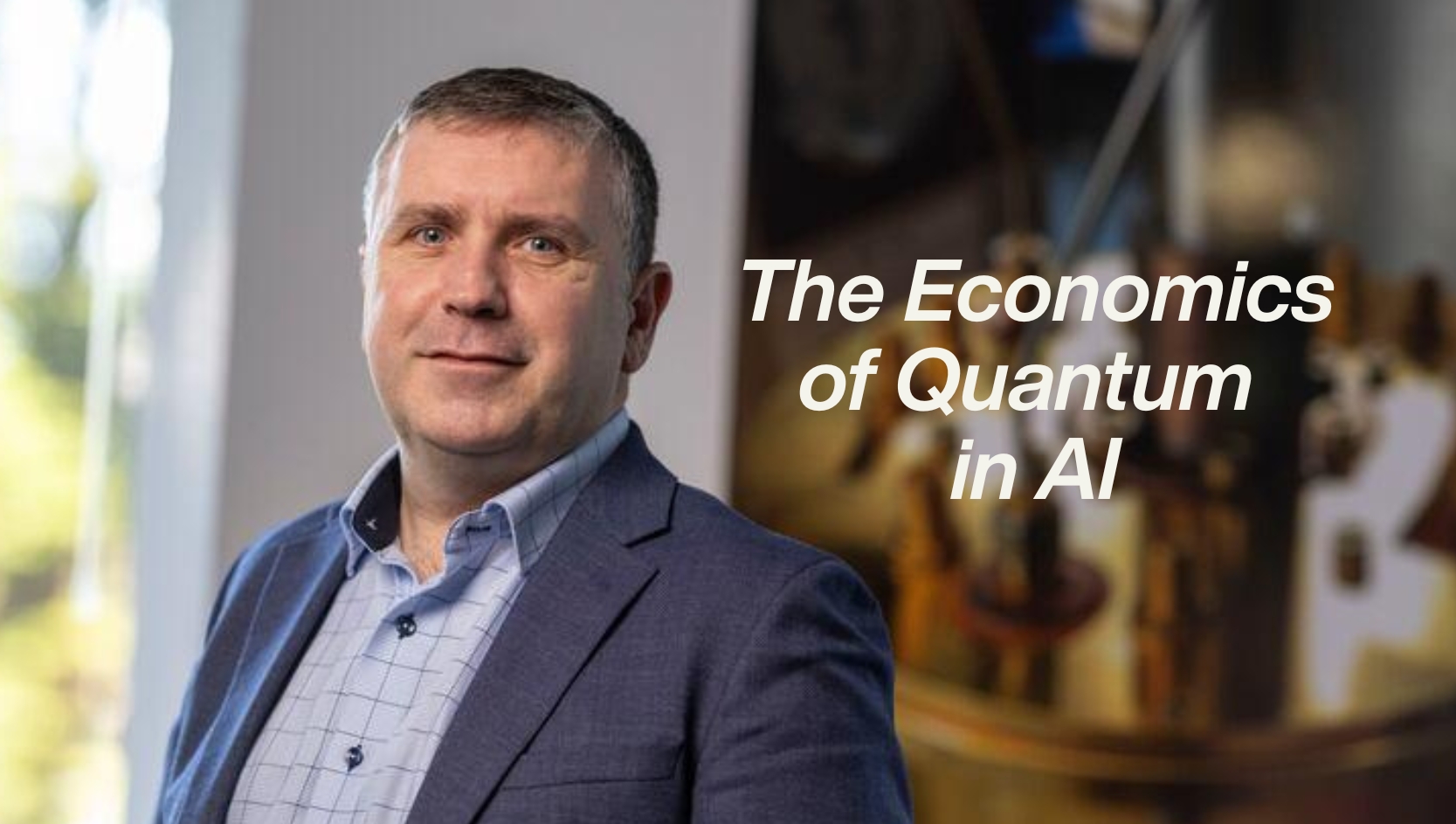
1.6 kW against 100 kW: The Economics of Quantum in AI

Blog
November 15, 2026
by Jason Lynch, CEO
In this three-part series, we've explored how quantum starts as an AI accelerator, why proximity matters for performance and how AI and quantum computing can work together to tackle increasingly complex problems. Now, let's turn to another critical factor: the economic question.
There are already early results around energy.
Recent experiments have measured the energy used by real quantum hardware running parts of AI workflows. As the problems grew, the quantum processor's energy use increased much more slowly than the energy needed by a classical computer to simulate the same quantum computation.
When quantum advantage lands on a workload, it lands with an energy advantage attached.
The physical starting point is already interesting. Equal1's entire RacQ quantum computer, including its cryogenic system, is specified at 1.6 kW. Today's rack-scale Blackwell systems operate in a power envelope measured in tens to more than 100 kilowatts per rack and rising.
That isn't a performance-per-watt comparison. They're doing different jobs. But it shows why the economics are worth testing. If a quantum accelerator removes meaningful classical computation from a workload, the consequence isn't a computational advantage. It is an infrastructure advantage. Less classical compute, less power, less building, for the same answer.
Against the capital and energy now flowing into an AI infrastructure, that is a very significant economic question.
I don't think the useful question is whether AI "needs quantum." The question is where quantum first earns its place in the AI compute stack.
Those first wedges will be specific. A sampling problem. An optimisation kernel. A molecular simulation inside a drug discovery workflow. That is how every accelerator started. GPUs earned their place on graphics before anyone called them AI hardware.
As qubit count, fidelity, speed and error correction improve, the set of workloads where quantum makes economic sense expands. The wedge widens. Operators and developers build competence. The algorithms multiply.
Making quantum useful isn't only about better qubits. It is about making quantum deployable: fast enough, integrated enough, compact enough and economical enough to sit beside the classical machines it works with.
Find the workloads where quantum earns an advantage. Put the QPU close enough that the architecture doesn't throw that advantage away. Then measure what matters: time, energy and cost to solve.
Quantum doesn't need to replace the AI stack. It will become a core citizen in it.
Fits the rack. Co-located with classical compute. Hybrid by default.