technology
UnityQ. The quantum system-on-chip that makes quantum deployable
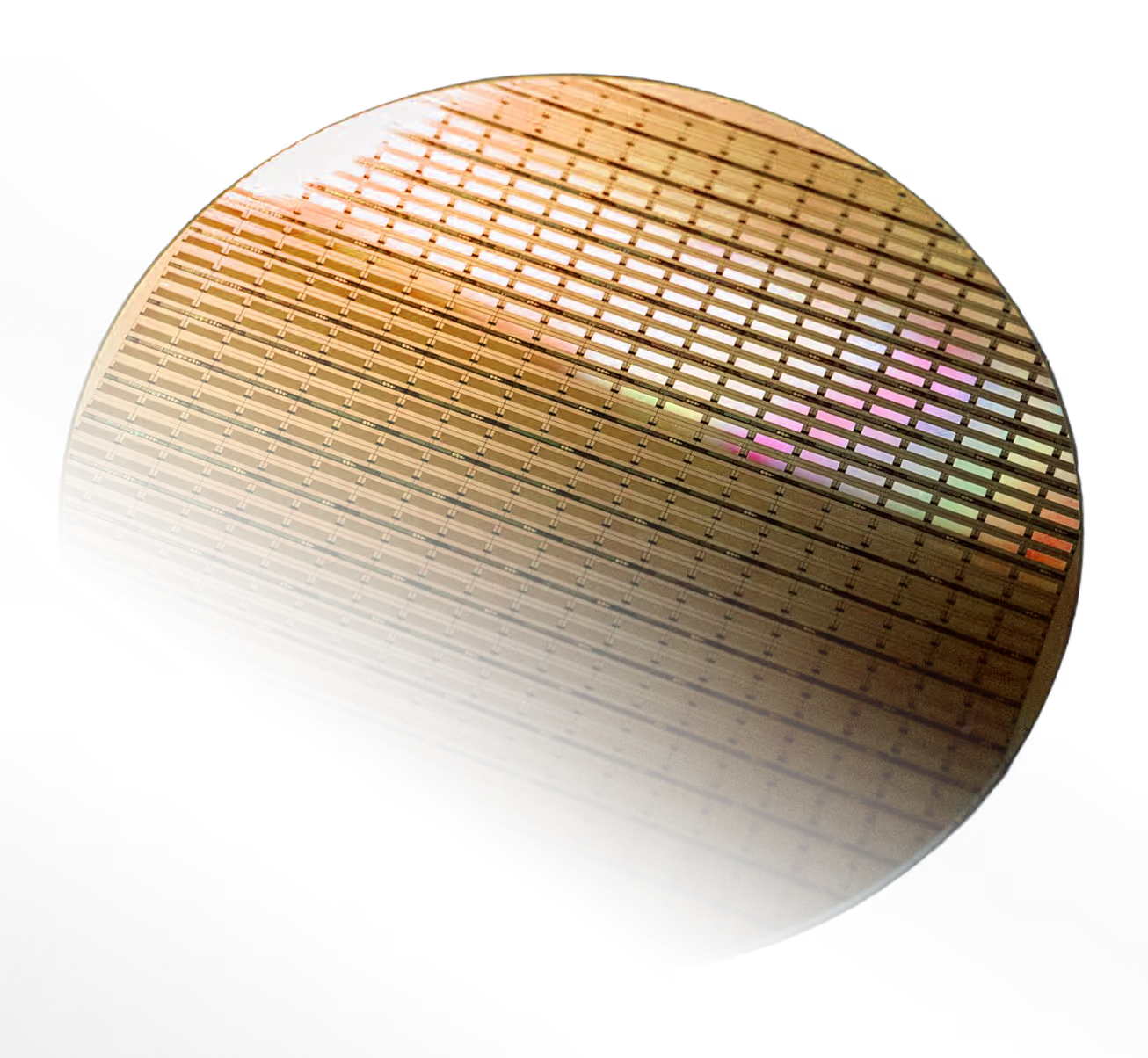
Qubits, control electronics and error-correction logic, integrated into CMOS silicon. The architecture that makes Equal1 RacQ manufacturable, deployable and upgradable.
.avif)
technology
Qubits, control electronics and error-correction logic, integrated into CMOS silicon. The architecture that makes Equal1 RacQ manufacturable, deployable and upgradable.
Quantum should deploy like real infrastructure.
Rack it. Connect it. Run it. No custom facilities, no specialist teams, no changes to existing infrastructure.
Quantum processing, alongside the CPUs and GPUs already running your workloads. Improving generation after generation.
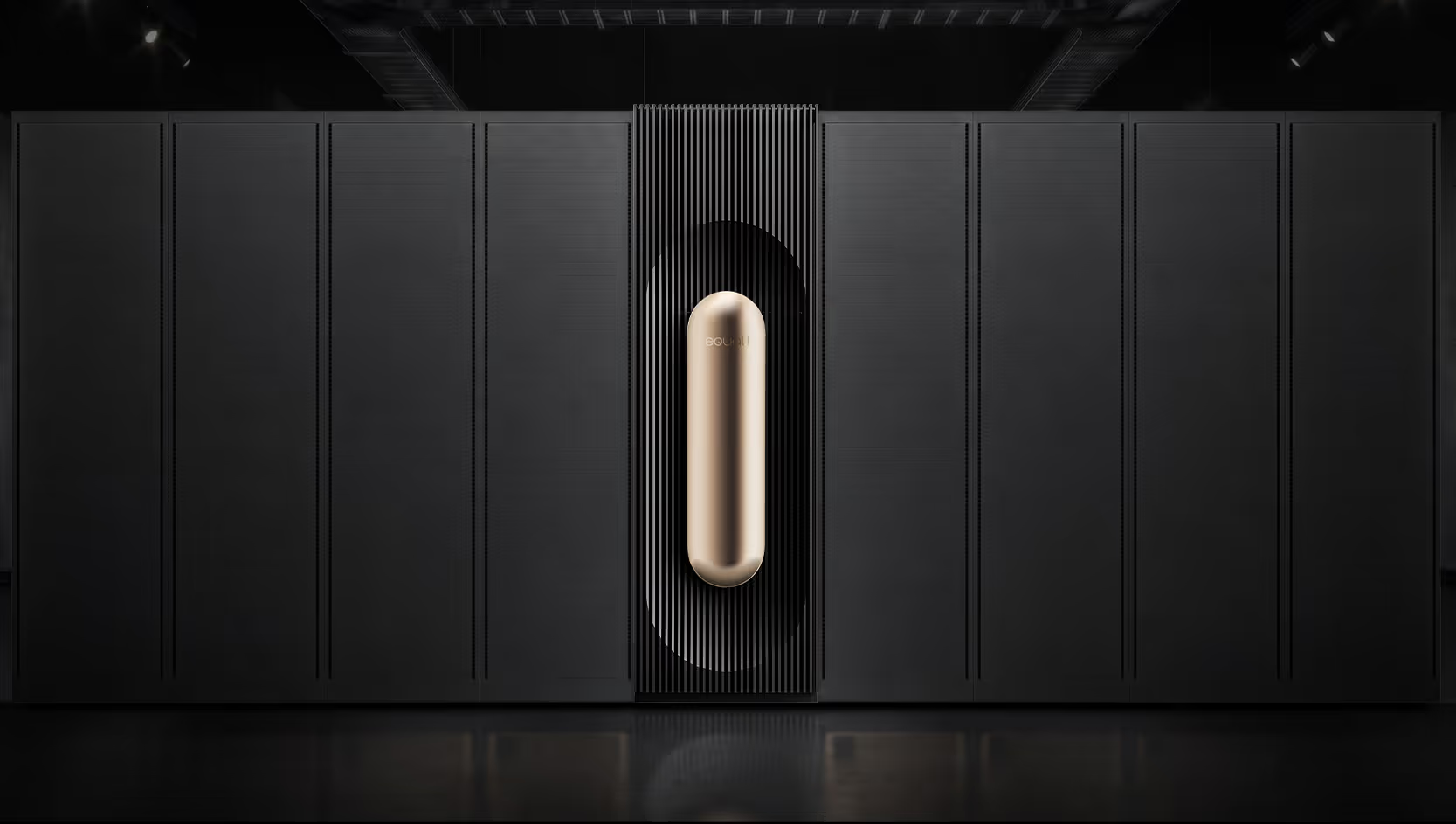
A quantum system-on-chip built on CMOS.
By integrating qubits, control, readout, logic and error correction in silicon, UnityQ collapses system complexity, enables repeatable manufacturing and scales quantum performance.
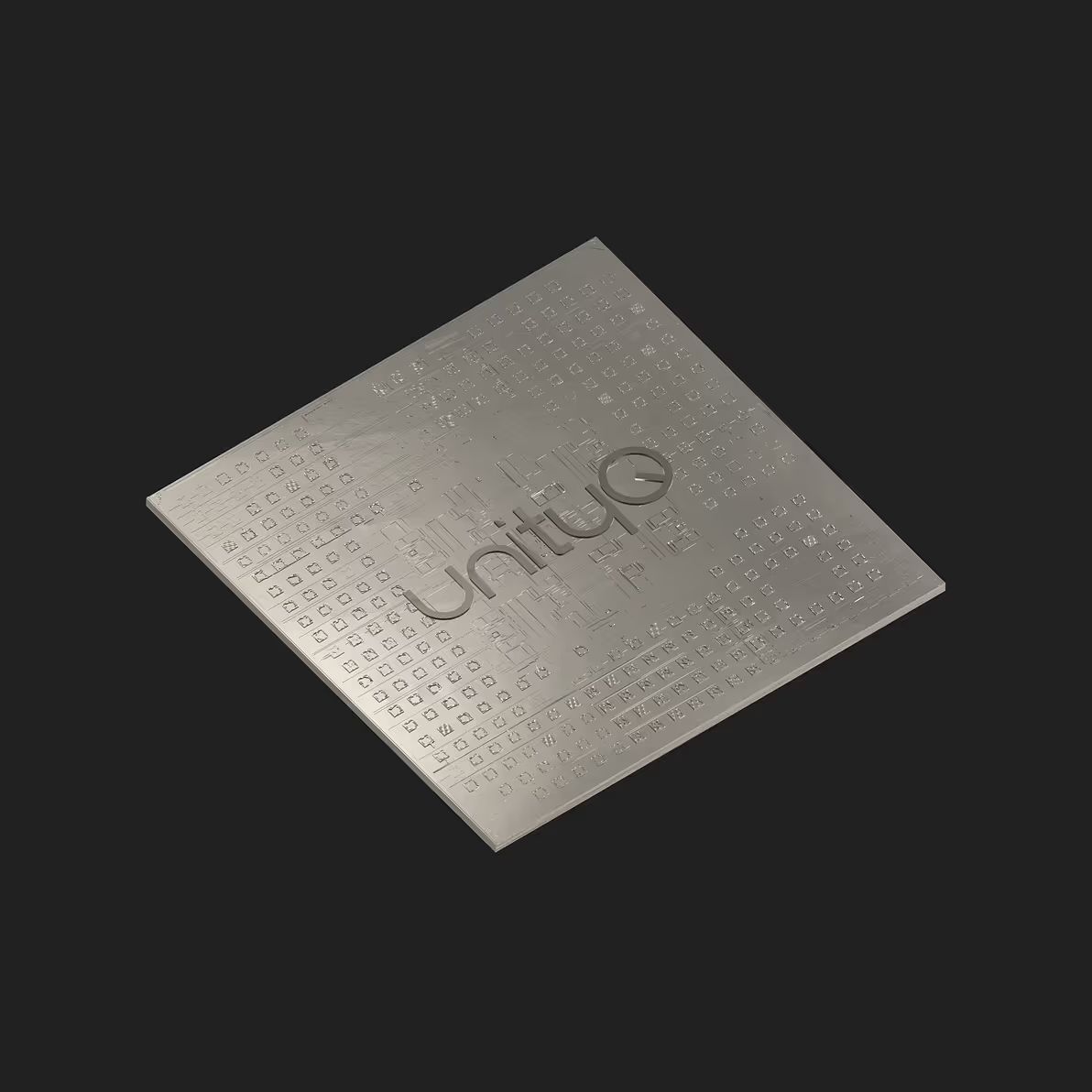
From a single qubit to a scalable quantum processor. Every layer designed as one
The quantum compute core. Every surrounding layer exists to control, measure and protect what happens here.
Precision control and measurement wrapped around the qubit array. At quantum scale, distance is error.
On-chip orchestration of every quantum operation and measurement. Cycle-accurate, every cycle.
ARM core, machine learning and error correction, integrated on-chip. Not bolted on.
A repeatable quantum building block: qubits, analog control, digital logic and correction integrated into one silicon unit. One tile. Many tiles. UnityQ.


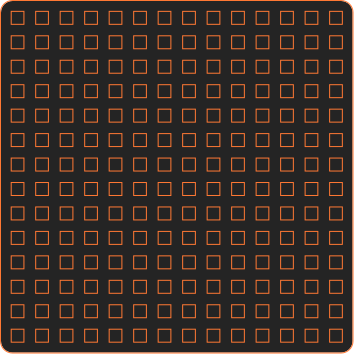


Control electronics traditionally sit outside the quantum system, introducing latency, noise and complexity.
Equal1 pioneered CryoCMOS: classical logic that operates at cryogenic temperatures. In UnityQ, it sits directly beside the qubits, bringing measurement and correction to the quantum layer itself.
At quantum scale, proximity unlocks performance. In UnityQ, less distance means lower latency, cleaner signals and correction fast enough to protect the computation.

Equal1’s silicon spin-qubit work has been measured, published and reviewed by the scientific community.
[1]
[2]
[3]
The first quantum processor with real-time error correction built-in.
Error correction is not just a software problem. It is an architecture problem. When control logic and qubits share the same chip, distance collapses, overhead drops and correction happens in real time.

More qubits. More protection. Every generation.
As UnityQ scales, more physical qubits are devoted to each logical qubit, increasing code distance and strengthening fault tolerance with every upgrade.
UnityQ does not just become more powerful. It becomes more reliable.

UnityQ is designed to scale through repeatable quantum tiles, each with its own qubits, control and logic. As generations advance, those tiles can operate in parallel, opening the path to larger quantum workloads on-chip.

focus-t01
QUANTUM CHEMISTRY & MATERIALS
Variational quantum eigensolver
Finding the lowest-energy configuration of a molecule.

focus-t02
QUANTUM CHEMISTRY & MATERIALS
nitrogen fixation · Fe–N₂
Computing how a reactant binds and activates at a catalyst site.

focus-t03
QUANTUM CHEMISTRY & MATERIALS
solid-state Li⁺ transport
Simulating lithium-ion transport through a solid electrolyte.

focus-t04
QUANTUM CHEMISTRY & MATERIALS
Hubbard model · cuprate
Computing the electronic band structure of a high-Tc cuprate.

focus-t05
DRUG DISCOVERY & LIFE SCIENCES
binding-pose scoring
Scoring candidate ligand poses against a protein binding pocket.

focus-t06
DRUG DISCOVERY & LIFE SCIENCES
free-energy landscape
Searching the folding landscape of a 60-residue peptide.

focus-t07
QUANTUM CHEMISTRY & MATERIALS
transition-state search
Mapping the reaction coordinate of an enzyme-catalyzed step.

focus-t08
QUANTUM CHEMISTRY & MATERIALS
base-pair minimum energy
Finding the minimum-energy secondary structure of an mRNA fragment.

focus-t09
FINANCE & OPTIMIZATION
QAOA · constrained mean-variance
Selecting an asset mix across 214 instruments under risk and liquidity constraints.

focus-t10
FINANCE & OPTIMIZATION
quantum Monte Carlo
Pricing an exotic basket option via amplitude-estimation Monte Carlo.

focus-t11
FINANCE & OPTIMIZATION
graph community search
Searching a 1.8 M-edge transaction graph for densely-connected subgraphs.

focus-t12
FINANCE & OPTIMIZATION
vehicle-routing · time windows
Solving the shortest tour across 120 delivery stops under capacity and time-window constraints.

focus-t13
AI · QUANTUM AI · CORE RESEARCH
supervised classification
Mapping data into a quantum feature space and training an SVM on the resulting kernel.

focus-t14
AI · QUANTUM AI · CORE RESEARCH
Born machine sampler
Training a parameterized quantum circuit to sample from a target distribution.

focus-t15
AI · QUANTUM AI · CORE RESEARCH
Schwinger model · 1+1 D
Simulating real-time dynamics of a U(1) gauge field on a 1+1D lattice
focus-t16
AI · QUANTUM AI · CORE RESEARCH
cryptographic primitive
Running period-finding to factor a 2048-bit integer.
Capability compounds inside the same rack.
Each new UnityQ generation increases compute performance without changing the deployment model. Same rack. Same infrastructure. No disruption. No rebuild.

UnityQ is the processor. RacQ is the system that ships it to your data center.
Together they bring quantum into your existing compute infrastructure — for workloads classical compute cannot solve efficiently.
Entanglement is one of the fundamental properties of a quantum state and is a crucial differentiator between classical and quantum computation. There are many ways to define entanglement and its measure, depending on the problem or application under consideration. Each of these measures may be computed or approximated by multiple methods. However, hardly any of these methods can be run on near-term quantum hardware. This work presents a quantum adaptation of the iterative high-order power method for estimating the geometric measure of entanglement of multi-qubit pure states using rank-1 tensor approximation. This method is executable on early fault-tolerant (hybrid) quantum hardware and does not depend on quantum memory. We simulate this algorithm and mitigate the effects of noise on the results of the computation using a theoretical model based on a known mitigation approach, which assumes a global depolarising noise channel.
Scalable quantum architecture for spin qubits will require efficient and reliable movement of qubits across increasingly complex architectures. This work introduces a physics-informed optimization approach to conveyor-mode spin qubit transport, leveraging device-level insights to improve transport fidelity and efficiency. By incorporating physical constraints directly into the optimization process, the method enables more realistic and scalable designs for qubit movement. It provides a pathway toward integrating high-performance qubit transport mechanisms within larger quantum computing systems.
Spin qubits and quantum dot arrays require precise control over qubit interactions and reliable readout mechanisms within scalable hardware platforms. This work demonstrates fully tunable tunnel-coupled quantum dots and integrated charge sensing in a commercial 22nm FD-SOI process. By enabling fine control over coupling and charge detection within a standard semiconductor technology, the approach supports the realization of complex and scalable quantum circuits. It highlights the potential of advanced CMOS nodes to host high-performance quantum devices while maintaining compatibility with industrial fabrication processes.
Future quantum technologies will depend on scalable and manufacturable hardware that can be integrated with existing semiconductor processes. This work demonstrates how electrostatically defined quantum dots can be controlled and reconfigured within a commercial CMOS platform. By leveraging common-mode voltage control, the approach enables confinement inversion, allowing flexible tuning of quantum dot configurations within the same device.
Quantum computers will require qubits that operate reliably within the limits imposed by error correction and practical hardware constraints. This work experimentally characterizes Si/SiGe spin qubits demonstrating high-fidelity single- and two-qubit operations at elevated temperatures compatible with integrated cryogenic electronics. By performing benchmarking, state tomography, and entanglement generation, the study shows that qubit performance can reach the error correction threshold even under realistic thermal conditions. This represents an important step toward scalable quantum systems where qubits and control electronics can be co-integrated.
Future quantum computers will rely on error correction, which in turn requires increased connectivity between qubits. To meet this demand, the proposed approach combines qubit shuttling with error-correction requirements, enabling more flexible and scalable architectures. By optimizing the physical layout starting from the constraints of the surface code, the work outlines a practical pathway toward efficient spin-based quantum processors. It also shows that near-optimal designs can be achieved with linear computational complexity, making the method applicable beyond small-scale demonstrations.
Fits the rack. Co-located with classical compute. Hybrid by default.