Blog
The Relationship between AI and Quantum

Blog
October 20, 2026
by Jason Lynch, CEO
Nature is quantum. The AI stack has to compute that way.
In my previous post, I argued that quantum starts in AI as an accelerator, and that proximity to classical compute becomes performance. Today, the deeper intersection.
Look at where enormous amounts of AI infrastructure are being deployed: pharmaceuticals, chemistry, materials science. AI can search vast spaces, generate candidate molecules, predict structures and rank the promising ones.
But many of these problems eventually run into something fundamental. Nature is quantum mechanical.
Accurately modelling molecules, electronic structures and chemical interactions becomes extraordinarily hard for classical computers as complexity increases. Not slower. Harder in a way that more classical compute doesn't fix.
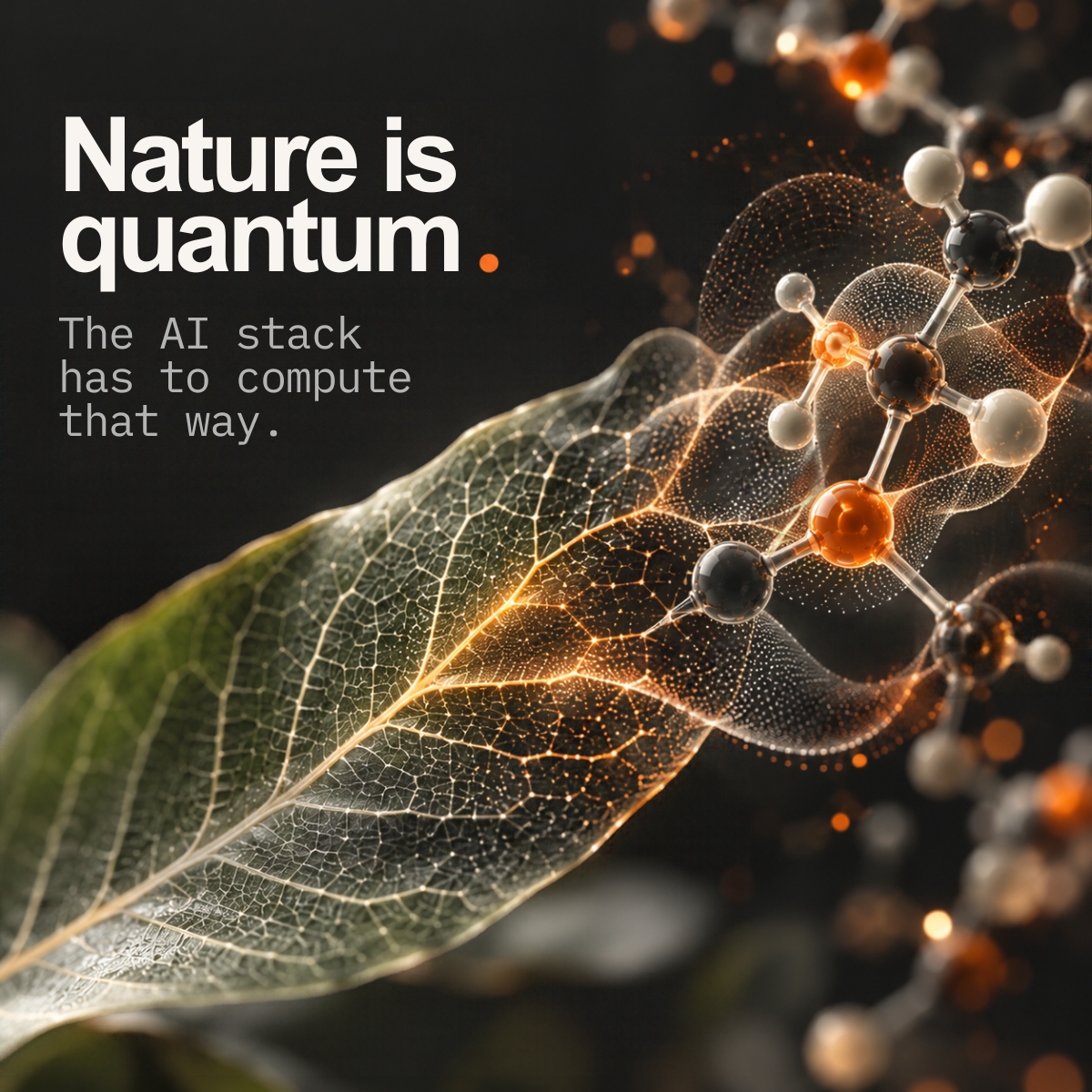
So the relationship between AI and quantum is complementary. AI searches. Quantum simulates. AI learns from the result. And the loop runs again.
Here quantum isn't accelerating an AI algorithm. It complements it with a different kind of computation; one built on the same quantum mechanics that governs the molecules and materials AI is trying to understand.
This matters for anyone forecasting demand. More powerful AI creates more demand for quantum computation, because AI lets us explore vastly more possibilities while increasing the need to evaluate the most promising ones accurately. The better the search, the more valuable the simulation.
And it is the same loop as yesterday. Classical proposes, quantum evaluates, classical learns. Which means the same architectural consequence: the QPU needs to sit close to the compute driving it.
That raises the question of what all this computation costs. In the next post I'll discuss the economics of Quantum in AI.
Fits the rack. Co-located with classical compute. Hybrid by default.